
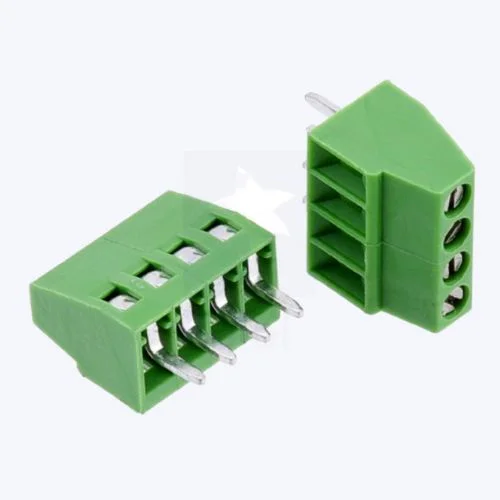
4-Pin Side-Entry Screw Terminal Blocks
Snap‑in, side‑entry 4‑pin terminal blocks make wiring projects quick, safe, and STEAM‑ready!
+0 points earned
4‑Pin Side‑Entry Screw Terminal Block – Connectors Category
The 4‑pin side‑entry screw terminal block is a compact, reusable connector that lets you secure bare wires or pre‑terminated leads to a printed‑circuit board, breadboard, or enclosure panel with a simple side‑insertion and screw‑tightening action. Each block holds four separate conductors, providing a reliable, low‑resistance path for power, signals, or sensor data in prototyping projects, robotics kits, and laboratory setups. Its robust metal housing and clear labeling make it ideal for students who need a fast, mistake‑proof way to build and re‑configure circuits without soldering.
Working with this connector teaches students core STEAM concepts: electrical safety (proper wire stripping and torque), circuit topology (how to route multiple signals cleanly), mechanical design (understanding how a side‑entry mechanism saves board space), and troubleshooting (identifying loose connections and verifying continuity). The hands‑on experience reinforces physics (Ohm’s law, resistance), engineering (design for modularity), and computer science (debugging firmware that relies on stable hardware interfaces).
Key Features
- Four independent terminals with 2 mm × 5.5 mm screw‑clamp contacts
- Side‑entry design for quick wire insertion and easy board layout
- Gold‑plated clamps for corrosion resistance and low contact resistance (< 30 mΩ)
- Polystyrene housing rated for 250 V, 10 A per terminal (UL‑certified)
- Color‑coded labeling (A‑D) and optional removable cover for protection
Because the block is reusable, tool‑light, and visually intuitive, it aligns perfectly with STEAM curricula that emphasize iteration, interdisciplinary problem‑solving, and real‑world engineering practices. Students can rapidly prototype, test, and refine their designs, gaining confidence in both the theoretical and tactile aspects of modern electronics.