
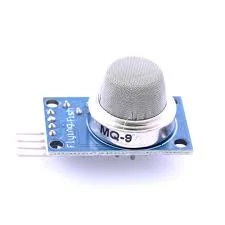
MQ-9 CO Methane Liquefied Gas Sensor Module
Detect CO & methane in real‑time, empowering students to explore air quality with hands‑on STEAM science!
+0 points earned
MQ‑9 CO Methane Liquefied Gas Sensor Module – Environmental Sensors
The MQ‑9 is a compact, plug‑and‑play gas‑detection board that continuously monitors carbon monoxide (CO) and methane (CH₄) concentrations in the air. Built around the proven MQ‑9 semiconductor sensor, the module includes a built‑in heating element, analog voltage output, digital PWM output, and a calibrated on‑board reference circuit, so it can be connected directly to any Arduino, Raspberry Pi, or micro‑controller development kit without additional circuitry. Its rugged enclosure and low‑power design make it ideal for classroom labs, indoor air‑quality stations, and portable environmental‑monitoring projects.
Students using the MQ‑9 will learn how to measure, interpret, and visualize real‑time pollutant data, gaining hands‑on experience with sensor calibration, signal conditioning, and data logging. They will explore the chemistry of combustion gases, the physics of semiconductor sensing, and the impact of CO and methane on human health and climate change. By integrating the sensor with coding platforms (Python, C/C++), students practice algorithm design, statistical analysis, and IoT communication; key STEAM competencies that bridge science, technology, engineering, art, and mathematics.
Key Features
- Dual‑gas detection (CO 0‑1000 ppm, CH₄ 0‑10000 ppm) with separate analog (0‑5 V) and digital PWM outputs
- On‑board temperature compensation and auto‑gain control for stable readings across 0 °C–50 °C
- Easy‑mount header pins, compatible with Arduino, ESP32, Raspberry Pi, and STEM kits
- Low standby current (≈ 80 µA) and fast warm‑up time (< 60 s) for battery‑powered projects
- Comprehensive starter guide, calibration curves, and example code for real‑time graphing
Because the module blends real‑world environmental relevance with programmable hardware, it sparks curiosity about air quality, encourages problem‑solving through data‑driven design, and provides a tangible entry point to interdisciplinary STEAM curricula from chemistry labs to robotics and smart‑city prototypes.