
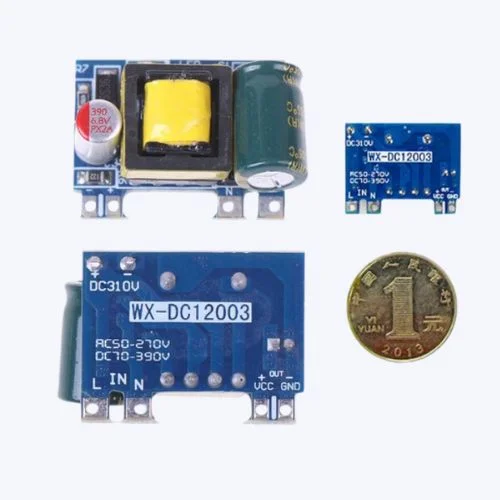
WX-DC12003 AC-DC 5V 3.5W Power Supply Module
Boost STEAM projects with the WX-DC12003: stable 5V/3.5W power in a compact module.
+0 points earned
WX-DC12003 AC‑DC 5 V 3.5 W Power Supply Module – Modules Category
The WX‑DC12003 is a compact, plug‑and‑play AC‑DC converter that transforms a standard 120 V (or 230 V) mains input into a stable 5 V, 3.5 W DC output, perfect for powering microcontrollers, sensors, LEDs, and small‑scale robotics projects. Housed in a rugged ABS case with a built‑in safety fuse and reverse‑polarity protection, the module connects via a simple barrel‑jack or screw‑terminal, making it ideal for classroom benches, maker‑space kits, and portable prototype boards.
Using the WX‑DC12003, students explore the fundamentals of power electronics: how voltage is stepped down, why regulation and filtering matter, and how to safely interface high‑voltage AC with low‑voltage digital circuits. Hands‑on labs let them measure input/output waveforms with a multimeter or oscilloscope, calculate efficiency, and diagnose common faults such as overheating or voltage droop. By integrating the module into projects; Arduino‑driven drones, IoT weather stations, or animated art installations, learners see the direct impact of reliable power on system performance and reliability.
Key features:
- Wide input range: 100‑240 V AC, auto‑sensing for global use.
- Fixed 5 V DC output, 3.5 W max: ideal for most low‑power development boards.
- High‑efficiency switching regulator (≥ 85 %): minimizes heat and extends battery life in portable designs.
- Built‑in safety: over‑current fuse, short‑circuit protection, reverse‑polarity guard, and EMI filtering.
- Compact footprint (30 mm × 20 mm × 12 mm) and low profile: fits into tight enclosures and breadboard rows.
Because power is the invisible backbone of every electronic system, the WX‑DC12003 gives STEAM educators a reliable, teachable platform to bridge theory and practice. It demystifies electrical safety, energy conversion, and system integration while freeing students to focus on creative problem‑solving, whether they’re coding a sensor network, building a kinetic sculpture, or prototyping a wearable device. The module’s plug‑and‑play simplicity accelerates project timelines, allowing more classroom time for experimentation, iteration, and interdisciplinary collaboration.